Simulating Uniquely Modified Objectives
June 27th, 2026 | by Andreas Richter
(4 min read)
We all are looking for tools to produce results instead of working on the tools and methods. We want to utilize and not develop. Simulation is one of the most promising tools to create results for planning and decision making. At GEONATIVES we spend some time to improve simulation by making them more realistic and therefore more reliable.
The simulation framework SUMO is one of the widely used applications to work in the domain of multi-modal mobility simulation. It is open source and utilizes various data inputs such as OpenStreetMap, HERE maps and ASAM OpenDRIVE data. Therefore it is often the primary choice of tools to answer your research question.
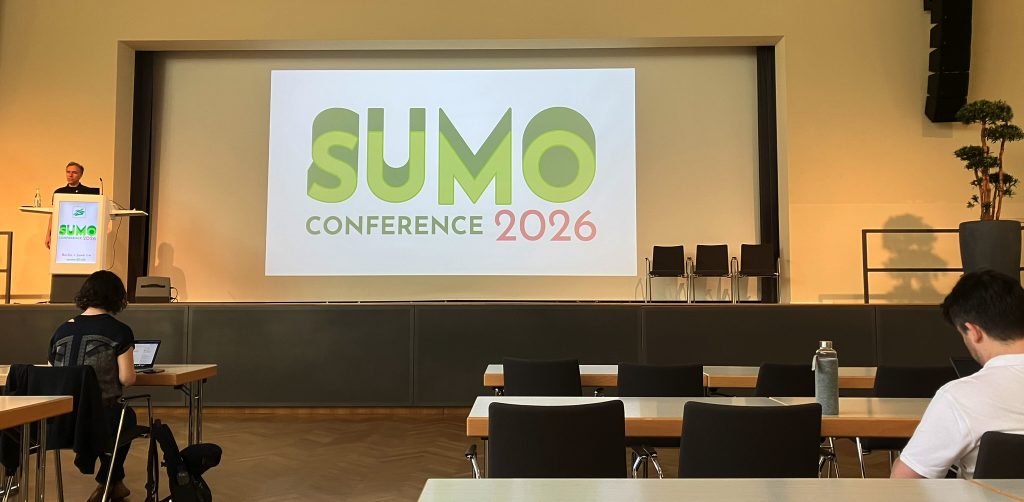
We spent some time at the SUMO conference 2026 and experienced some similarity with the Driving Simulator Conference: Various presentations and posters are dealing with fine-tuning your application, either your microscopic traffic simulation to adapt the driver model resp. the demand model as well as the road network and intersection layout to the reality or your dynamic driving simulator to adapt motion queueing and vehicle dynamics to your hardware setup. Sometimes it is like listening to the same story again but with slight changes in the starting conditions: different city, different data availability, different motion platform, different latencies and limitations. But the story stays similar:
- Getting the tool that is widely used and believe that it works outside the box.
- Organizing Data for the simulation setup and realizing that the data is always not complete and lacks details you might need.
- Start to collect data by measuring your own use case.
- Manually fine-tune the simulation with measured data for your exact use case.
- Compare simulation results with reality and try to interpret the difference.
- Agree that the simulation is now as close to reality as possible and start to work on the initial research question.
- Come up with results that might improve the local situation. Transfer the results to different locations is future work.
The research question often focuses on “local” problems (e.g., improve traffic flow in a borough or make the dynamic driving simulator feel real) and in general that works well. Is it applicable to similar research questions? No, because the data looks different or even is not available, the driving behavior or mode selections of the citizen are different, the hardware setup and motion envelope of the simulator platform are different.
Is it worth to listen to solutions with similar/same tools if you can’t directly benefit from the researcher’s findings for your own tasks?
Yes, because it is not always just “copying” the setup — because there is no “one size fits all” — it is about to “learn” which steps were conducted to tackle the task and which parameters where adjusted at the end. It is also worth to understand why some solutions were not applied, because sometimes there is a good reason for that (that can be presented by additional test runs) or because simply there were no resources available or even the researchers were not aware about the additional solution.
While listening to the various presentations and reading the posters at SUMO 2026 conference you would get the feeling that everybody is blaming SUMO to be not good enough. Everybody was telling about issues with the imported road network, missing traffic light plans, false strange traffic demand generation, unsuitable mix of traffic participant types, too ideal car following, too bad routing, missing interaction with pedestrian, etc. But how should SUMO know about all the quirks of local behavior? Can you blame SUMO that OSM mappers are mapping to get an good-looking map instead of a working road network definition for traffic simulation? How should SUMO know about traffic light plans if they are often treated as state secret?
In fact SUMO framework with all it’s auxiliary tools to import and automatically fix (means best guess) road networks and come up with meaningful traffic light control even for complex intersections, connect to other simulators which can take over control or compute more proper movement/decision making supports you already with all might to make the application work for you.
This situation is similar to the Driving Simulator Conference: Yet another “improved-motion-queueing-for-our dynamic-driving simulator-which-has-a-specific-setup-because-we-wanted-to-have-a-better-installation-than-every-other-dynamic-driving-simulator-before-(even-with-limited-budget)” paper that explains how motion queueing was designed, applied, validated and finally agreed to be good (but for sure there is future work) or a paper that deals with how to get a test track or specific stretch of road very precisely into your simulator by conducting sophisticated measuring and applying manual polishing. Sometimes even new data formats are popping up because the already existing ones are too complicated or less efficient but at the end the inventors are modeling the same world with similar approaches again.
Worth listening? Yes, because again you can learn about what and why the researchers did what they did and why they didn’t what they didn’t. Additionally often presentations and posters are popping up explaining new improvements (as we did) or using the tools “outside the box”.
Additionally — and this is common for all conferences — you easily get new impulses for your work, become aware of new solutions and sometimes listen to surprising results and all of that is a good foundation to collaborate. Thus, see you at the next conference!
About The Author
