Orientation of Language
March 29th, 2026 | by Andreas Richter
(4 min read)
Sometimes while looking outside the box we find interesting relations to geodata. This time we came across a research from 2010 working on the relation of how our mother tongue influences our ability to memorize, explain, and describe situations. Research revealed that language impacts the way we locate things and put them in order related to time.
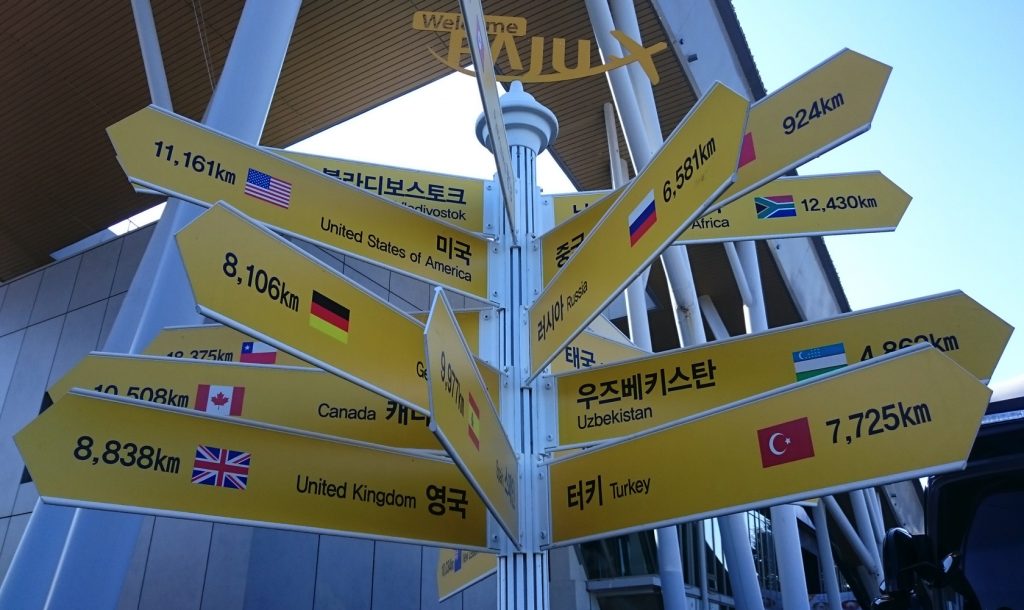
The German language is ego-centric and works with relative terms to locate thinks. Terms like left, right, front and back vary depending on the orientation of the speaker. If someone turns around right becomes left and vice versa. Germans which are not so familiar with geodata often use these terms also on a map, which implies that everybody agrees that north means “up”. Often this is the case — even fictional maps such as the map of Middle Earth were oriented in this way.
By the way: “orientation” comes from looking at the Orient, which was previously scientific high culture (ancient Near East) to get some guidance. “To orient” is derived from where the sun rises which happens in the east (where the Orient is located).
But ancient cultures (e.g., Europe until the 15th century) often had a 90 degree rotation in the map, following the position of the sun. Because the sun rises in the east, it was the most obvious thing to put east at the top. But sometimes the map was oriented according to the flow of an important river such as the Nile in Egypt. The source was at the top, and the flow down to the bottom means that south is on the top and north at the bottom. The north got more popular with the help of navigation and the compass and usage of the magnetic field of earth. In China where the compass was invented the decision was to define the direction of the compass needle to south. In Europe navigation often worked with the North Star as fixed point. When the advanced technology from China got adopted by the Europeans they reorientated the south-pointing-needle towards north. Putting the map also in north-orientation makes it easy to navigate with a compass. And because the European were “successful” in “convincing” the rest of the world of their understanding the rest of the world got north-oriented too. But we can get rid of this if it comes to ego-centric navigation where the map is rotated according to the orientation of the user (e.g., displayed by navigation devices) and sometimes maps of rectangularly laid out cities get out of line if the streets fits better on a sheet of paper (e.g., compare the subway map of New York, NY US with a corresponding road map).
While we read from top to bottom we also often agree that things which are on top are more worth than others at the bottom. You could interpret this as Northern Europe being better than Southern Europe, and North America better than South America. But sometimes this is not working, for example if you compare North and South Korea. The Australian geographic teacher MacArthur came up with a corrective map of the world and put it upside down. Even more complicated: For everybody living in Antarctica all directions are pointing towards north (and it’s very hard to walk east from the North Pole). Differentiation of directions gets very complicated.
Back to orientation: Other languages are not ego-centric such as the Aborigines language Pormpuraaw. People speaking Pormpuraaw are located on the west coast of Cape York Peninsula, Australia. They are using cardinal directions (which means absolute location such as north, south, east, west) to locate things. This is also used even if subjects are close to the speaker. Your coffee cup for example is not in the front right but in the north-east. You need a superior knowledge of spatial orientation to communicate between two persons. You really have to be absolutely oriented to be able to express yourself.
In research it got more interesting when fourteen study participants were supposed to put pictures of the same person but of different ages or general time events into an order without any further instructions. Because most of our language works from left to right (and reading from top to bottom – see above regarding the importance of things at top) we would put the picture with the youngest person leftmost and the oldest one rightmost. However, the Pormpuraaw put them always from east to west independent of their own orientation (which means not just from right to left). This was tested in different settings where the study participants had to change location.
It is worth mentioning that there are also languages which are more “mountain-oriented” instead of left-right. Some languages in Nepal use terms such as “uphill” and “downhill” for orientation based on the current location. Your cup of coffee could be either uphill or downhill depending on where the next mountain is located. This communication works quite well if your subject of communication is always regional (focusing on the life in a valley) and has no need of addressing global scale.
Different concepts can be applied to solve the same problem and dependent on the requirement a local solution works and a global one is not required. Getting inspired from outside the box (i.e., outside of your geofence) can always broaden horizons.
Reference
Boroditsky, L., & Gaby, A. (2010). Remembrances of Times East: Absolute Spatial Representations of Time in an Australian Aboriginal Community: Absolute Spatial Representations of Time in an Australian Aboriginal Community. Psychological Science, 21(11), 1635-1639. https://doi.org/10.1177/0956797610386621
About The Author
